Friday, October 17, 2008

Photos by Catherine


The Roof

 I love the roof.  It is a large space on top of the apartments.  People hang their laundry on ropes tied around water towers made of concrete.  The roof is much larger than it appears in the picture, the water towers you see father away are also part of the roof.  My sister my mom and I, go up there for the breeze during the daily power outage at 3:00, lasting until about 4:30.  It is so hot inside, that we need to go up to the roof to escape the heat. Sometimes, the power goes out a lot earlier, like today-- 11:00.  During the power outage, we can't even get the Internet.  The roof is really big, and it is very high up, so it escapes most of the heat.  Of course, you have to wear shoes on the roof or else your feet will burn.  I find that in India, it is better to test any metal that has been in the sun for a long time before touching it.  It is the same for the floor of the roof.  The roof is really fun and I go there whenever I can.

Isabel 

10/17/08

The Breezy Beach


The Breezy Beach
     The beach that at the end of our street is part of the Bay of Bengal. The Bay of Bengal connects to the Indian Ocean.  Our beach is called Breezy Beach.  The name tells the truth; it is fantastically windy.   
     Every evening I go to the beach with my dad and my sister. Sometimes my mom comes but mostly she does not come. I sometimes go in the water. The waves are pretty big.  Other times, I build sand castles and find clams and call one Mr. K and the other one Mrs. Q.  Mrs. Q and Mr. K try to get away when you put them in water and you see their foot.  The clams are longer, more brightly colored, thinner and smoother, than the ones that are found in Connecticut.  
     The crabs here look a little strange. Their eyes are directly one top of their head.  The crabs are sand-colored and they dig holes in the sand.  They are everywhere.  I like to run on the beach and chase the really big crabs.  They run away into the water.  They are super fast.  
     People throw plastic garbage bags of flowers into the ocean.  My dad thinks it's a funeral ritual but we're not quite sure.  
      Breezy Beach is connected to a walkway that is called the Breezy Beach Walkway. There are puppies on the walkway but mostly we see people on the Breezy Beach Walkway.  They are running, sitting, walking, bicycling and doing yoga. There are lots of street dogs on the Breezy Beach Walkway.  They look like they are exercising too except the dogs are not bicycling or doing yoga.  
     There are always interesting things happening on Breezy Beach and its walkway.  

Clio 
10/17/08

Monday, September 22, 2008


We live in an apartment in Chennai that has a living room, a dining room, two bedrooms, two bathrooms, a kitchen, and a balcony.  In the living room there are two red chairs and a red couch.  In the dining room there is a dining table, and a table for the electronics.  There are step-down plugs and adapter plugs so we can charge our things.  My sister and I share a bedroom, and my mom and dad share another.  The balcony is level with the treetops, and you can often see little tree squirrels that look like chipmunks with long, fluffy, striped squirrel tails.
    Every morning, my mom wakes me up at 6:00 to go on a walk on the beach with her, my dad, and my sister.  There are lots of people stretching and jogging on the beach at that time of day because that is the only time it is cool enough to walk.  There are fishing boats on the shore and they are all painted in bright colors.  There are also boats made of logs tied together.
Isabel 22/9/08


 MY FIRST DAYS IN INDIAby Clio
I went to India on September 15th and got there two days later. I was so tired.  The apartment we rented is nice.  When we went on a walk.  We saw monkeys and their babies.  They were really cute.  There are lots of dogs on the streets.  Mom wakes us up at five in the morning to go on an exercise walk. It's very tiring. We do home schooling every morning.  So far it's been fun.

Tuesday, September 9, 2008

Coyote Stompers: Wimberley, Texas


1st photo: Cousins Clio, Marina, Isabel and Leo
Wimberley, Texas
-note the ever present Action Man

My grandparents took my cousins, mom, sister, and I, to see some donkeys. Their names are: Jenny, (she is the mother) Jack, (he is the father) and Jackson, (he is the baby). We got to feed Jack and Jenny. My grandparents are being giving Jackson because they have deer and the coyotes eat the deer. They need to
protect the deer so they will get Jackson.

Clio 9/08

2nd photo: (Future coyote- stomper) Jackson with his mother Jenny (supreme varmint killer).

Saturday, September 6, 2008

The Blue Hole, Wimberley, Texas


In August, I went to the Blue Hole with my cousins. The Blue Hole is in Wimberley, Texas. I climbed a big, forty-five foot cypress tree with only knots for the first forty feet. I wanted to swing from the tree on a rope swing with a wooden bar. I had to pull the swing up using a rope attached to the swing. I had to take the rope off and step off the tree. I bear climbed to get the rope and it felt like I was going to be pulled off the tree. Then I stepped off and I fell a little, then the swing caught me.

It was scarier then last year, because there was no one there to help me and I didn’t have to get the rope myself because they handed it to me. Another reason it was scarier was because no one else was doing it. Last year I was able to do it five times. This year I was only able to do it once and I felt tired afterwards. The Blue Hole was really fun.

Isabel


Wednesday, July 16, 2008

Whale Watching off Provincetown, Cape Cod, July 12, 2008


At 9AM on July 12th, C, B, I and C, accompanied by our old friend Tara Perry, boarded the Blue Dolphin VIII, a whale watching ship out of Provincetown, MA. After a brief trip out of the harbor, the ship headed north along the tip of Cape Cod into an area the ship's captain and naturalist had seen whales the previous few days. The area is rich with plankton, the base of the ocean's food chain, and therefore the fish which humpback, fin, minke and the other whales that frequent these waters in the summer feed on.

Sure enough, just a few minutes after clearing the Cape people began shouting out that they saw whales, humpback whales. We could see them one or two miles away surfacing to breathe, humping back into the water, sometimes with their tales - flukes - high in the air.


The ship began to move closer to one whale named Reflection. The naturalist, Mike Bertoldi, and the captain see the same whales every year and can identify many of them by the markings on the underside of each whale's fluke. The dorsal (or back) fin is also differently shaped from animal to animal. Professional whale watchers and scientists keep logs of the animals they encounter and share them with each other, so there is a detailed record of the whales that frequent these waters year after year. We followed Reflection who came close enough for us to see her dive and come up for air several times before she moved off.


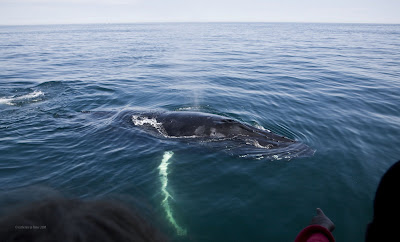
We had some fairly close encounters, including one which went almost directly under the bow of our ship. It was so close we could see its face, the light color of its side - or pectoral - fins, and tubercles, the bumps on the whale's head. We even got wet with a whale's spray! Mike Bertoldi joked that we had just gotten rained on by whale's snot - but we didn't mind. In the picture below, the white line under the whale is one of its pectoral fins.


Perhaps the most amazing thing we saw was whales feeding. First they slap the water with their flukes and dive down below. Then they create something called a bubble net underneath a school of fish. Blowing bubbles deep in the water they swim in a circle which scares the fish upward and inward, trapped in a tube of bubbles. Then the whales come straight up with their mouths open wide and catch fish at the surface of the water. Sometimes they do this in pairs, as in the picture at the top of this entry.

Catherine knew where to aim her camera to get this amazing picture because you can see the bubble net forming as the dark green water turns light - almost florescent - green in a circle just before the whales come up to the surface. The seagulls know where to go, too, and there are lots of them flying around just above the bubble net hoping to snatch a fish. We could see the gulls flock about the heads of the whales, very close to their mouths. Mike the naturalist told us that he has seen birds get caught in whales' mouths; the whale's throat is only the size of a grapefruit, so it has to surface again to spit the bird out. "The birds never look happy," he said.

Other than these close encounters with twelve or so whales, we were in sight of some two dozen more between one and three miles away. There were moments when we could see whales coming to the surface to breathe, feed, or on one occasion, breach, wherever we looked. They were all around us. It was amazing. We were seeing whales.

That said, the naturalist told us that there are only about 80,000 humpback whales in all the world's oceans. That's not many, perhaps only one tenth their numbers before whaling. Scientists have only been studying whales seriously for about thirty years; naturalists on board the old whaling ships had made drawings of their bodies, inside and out, but we only recently started studying them in the wild.

It struck me that we would be a much wiser people if everyone got a chance to see wild whales at least once. BB